


In the modern Concrete Construction industry, Ultrasonic Pulse Velocity (UPV) is one of the most effective non-destructive testings (NDT) method for quality control (QA /QC) of concrete materials, assessing and detecting defects, anomalies and various types of nonconformities damages in concrete structural components whether precast or cast in-situ.
Applications of Ultrasonic Pulse Velocity UPVU Testing of Concrete
- Pulse Velocity Determination
- Concrete Quality Assessment
- Establishing Homogenity and Uniformity of Concrete
- Measurement of Surface Crack Depth
- Prediction of Compressive Strength of Concrete
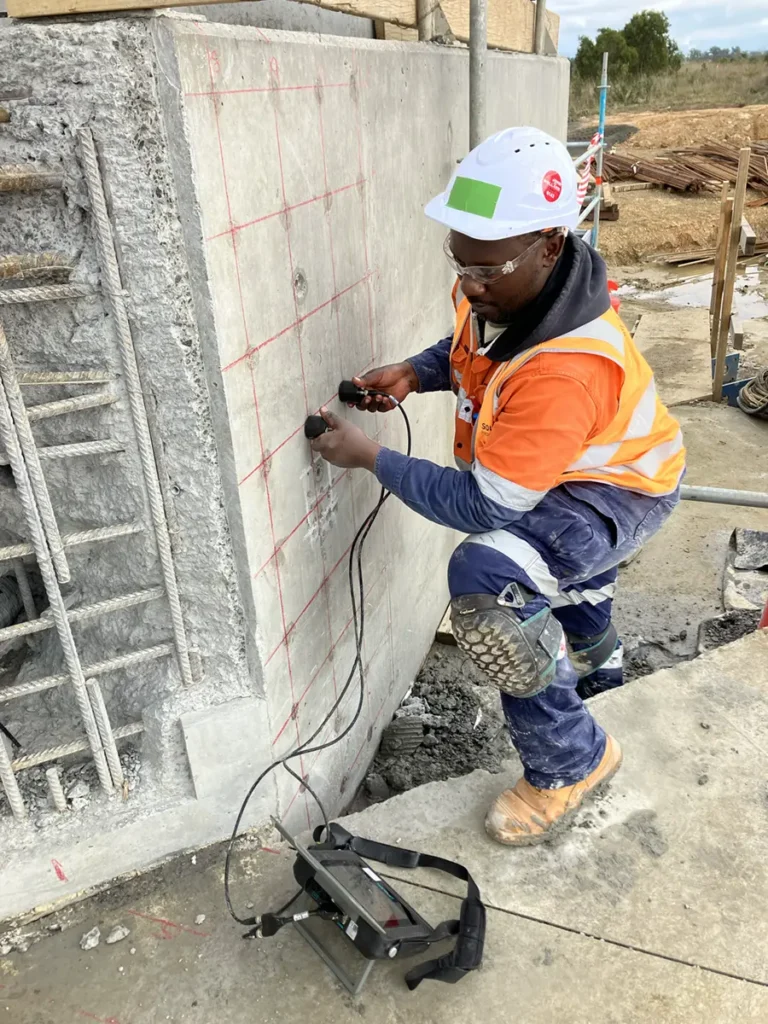
Technology Standard
Ultrasonic Pulse Velocity Testing was conducted, and data acquired in accordance with industry standards (ASTM C 597, 2016), “Standard Test Method for Pulse Velocity through Concrete” and similar equivalent standards / BSI 98/105795 DC British standards and American Concrete Institute / ACI 228.2R Standard.
For verification of acceptability and use of the above ASTM standards in absence of Australian standards refer to: https://www.vicroads.vic.gov.au/-/media/files/technical-documents-new/technical-notes/technical-note-tn-061–nondestructive-testing-ndt-of-concrete-in-structures.ashx
The standard offers a guiding testing procedure for pre-data acquisition surface preparation, gridding, testing / data acquisition, processing and interpretation.
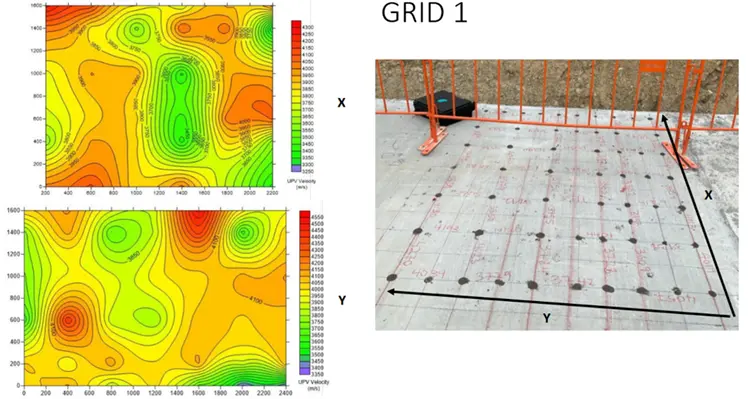
Developments in Ultrasonic Pulse Velocity (UPV) Technology
For the last 70 years, several studies and advancements have been conducted in the Ultrasonic pulse velocity technologies space and broadened it’s application primarily from the Steel non-destructive testing NDT industry into Concrete NDT and quality control. Numerous industry research projects have developed, rigorously tested and commercialised equipment, software and models solving Concrete grading, quality, homogeneity and in-situ Concrete compressive strength (in MPa / KPa units) based on Ultrasonic Pulse Velocity (UPV).