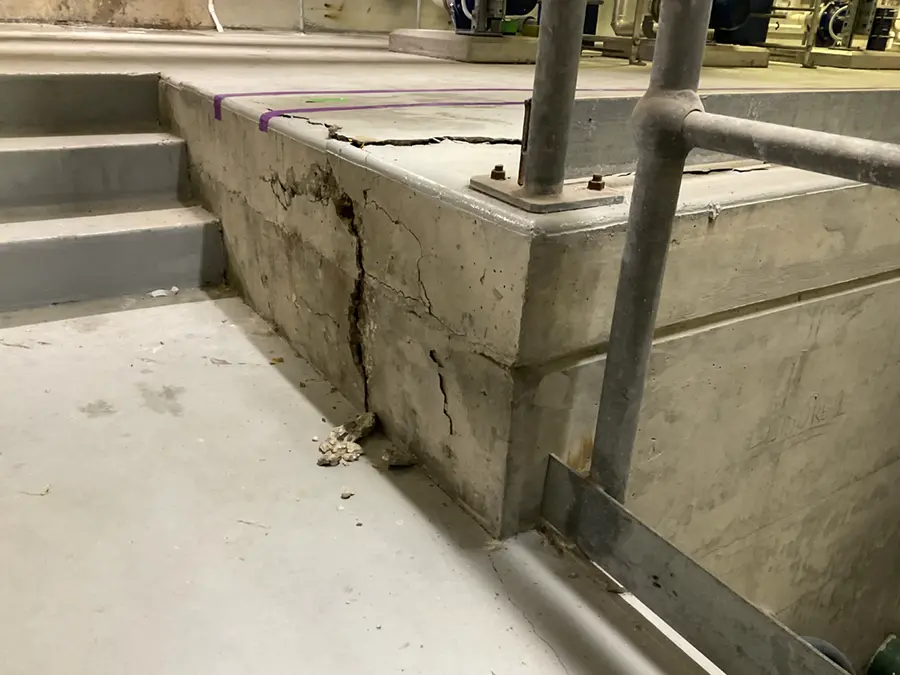


In modern day Construction industry and Condition assessment of structures, measuring crack length is not enough, however accuracy in measurement of depth-extent of Cracks, width of crack, profiling of crack-depth along it’s line of propagation in concrete, provides valuable information in assessing a Crack’s severity, diagnosis of the defect and suggesting effective remediation (repair) method.
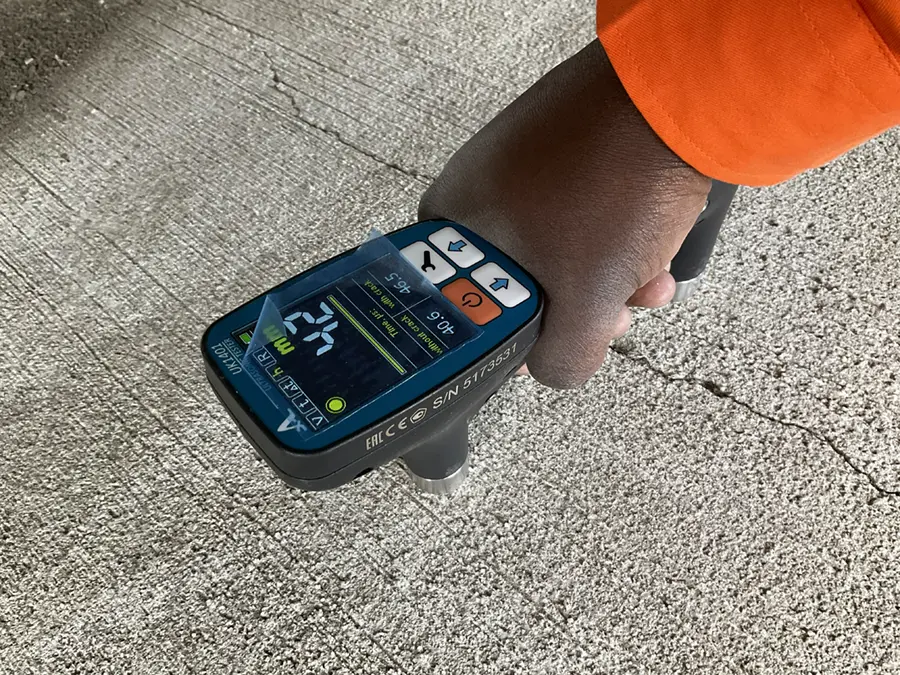
Ultrasonic Pulse Velocity Crack Depth Measurement determines the depths of vertical cracks in concrete in accordance with to BS 1881 standard logic.
Technology Standard Ultrasonic Tomography (UT) Imaging in accordance with ASTM C 597, 2016 “Standard Test Method for Pulse Velocity through Concrete and related standards BSI 1881 – Part 203, 1986, ASTM E 114-95, 920, 1995.
Technology Standard
Ultrasonic crack depth measurement in accordance with BS 1881 Part 203 1986 Recommendations for Measurement of Ultrasonic Pulse Velocity Through Concrete and ASTM C597 1999 Standard Test Method for Pulse Velocity through Concrete.
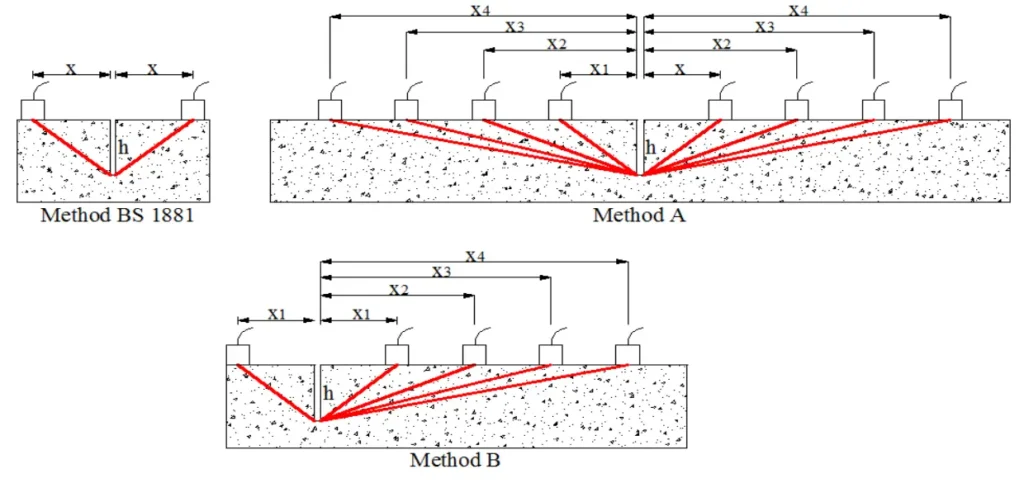
The method measures surface velocities in and/or near the crack and use a trigonometric formula to estimate the crack depth. The calculation assumes the crack is open and air filled and vertical
Physics of Ultrasonic Crack depth determination
The measurement of crack depth can be conducted by Ultrasonic Pulse Velocity Test (UPVT). The principle of this UPV testing work is to transmit the ultrasonic waves from the transmitter (Tx) to the receiver ( Rx) across a predetermined distance through concrete material. The ultrasonic wave velocity in concrete material is calculated used to accurately determine the depth of the crack.
Assessing severity of Cracks
Cracking is an early warning sign of structural overload and may initiate a mechanism of instantaneous or progressive structural failure in a concrete structure (reinforced or unreinforced).
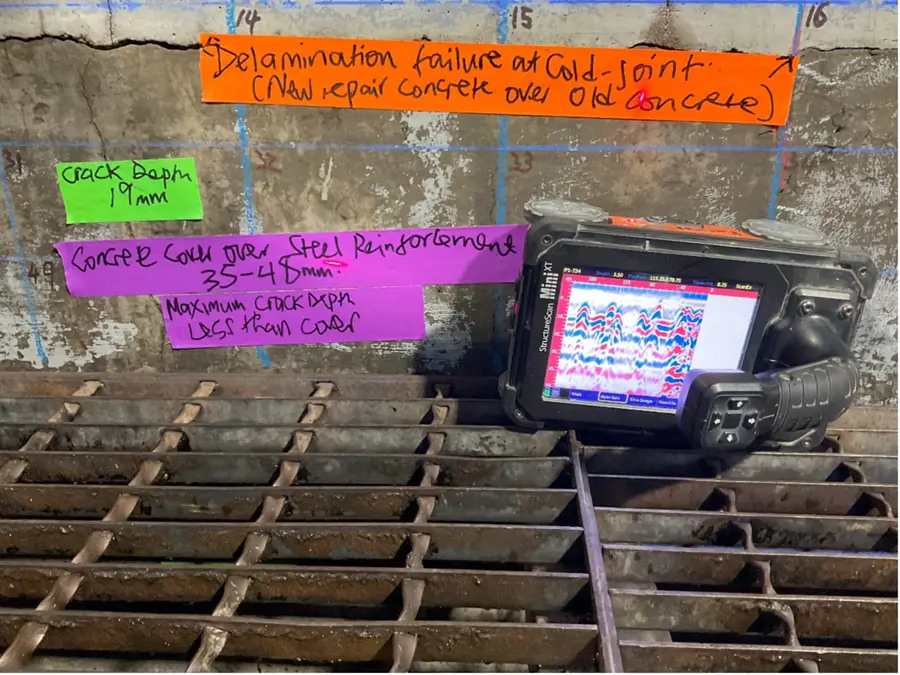
Severity of cracks depends if cracks are superficial (surface hairline cracks) or if the crack has propagated past cover, past Steel reinforcement (1/2 , ¾ or full thickness).
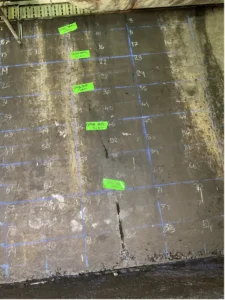
Adverse severity of Cracks
Cracking may not only significantly degrade a structure’s load bearing capacity but also, if a network of cracks / fractures is left unchecked (unsealed) they may progressively facilitate and sustain ingress of moisture and oxidative conditions which over prolonged time cause and accelerate corrosion of Steel reinforcements and progression of degenerative defects including expansion of cracks due to corrosion stresses by expansion of corroded Steel, Spalling of Concrete and loss of Cover.